Wednesday, January 18, 2023

Taekwondo Classes in Exton - Rediscovering Inner Strength Through Tae Kwon Do Training

Tae Kwon Do is a martial art that emphasizes physical and mental discipline. 

Through training, students can develop confidence, self-control, and determination. The physical demands of Tae Kwon Do can also help students build physical strength and endurance, which can contribute to a sense of accomplishment and inner strength. In addition, the structure and discipline of Tae Kwon Do classes can help students develop focus and concentration, which can help them feel more centered and in control of their lives. 

Overall, the physical and mental challenges of Tae Kwon Do training can help students rediscover their inner strength and develop a sense of self-confidence and self-worth.


There are a few ways that Tae Kwon Do students can increase their self-control through training:

Practice discipline and focus: Tae Kwon Do training requires focus and discipline in order to learn and execute techniques correctly. By consistently practicing these skills in class, students can improve their ability to control their thoughts and actions.

Learn to control emotions: Tae Kwon Do training can also help students learn to control their emotions, especially in high-stress situations. This can be achieved through practicing deep breathing and visualization techniques, as well as learning to stay calm and focused under pressure.

Set goals and work towards them: Setting and working towards goals, such as earning a new belt or mastering a new technique, can help students develop discipline and self-control.

Practice self-control outside of class: Self-control is a skill that can be developed and strengthened over time. Students can practice self-control in their daily lives by setting limits for themselves and working to stick to them.

Overall, Tae Kwon Do training can help students increase their self-control by providing opportunities to practice discipline, focus, and emotional control, and by setting and working towards achievable goals.

Physical strength and endurance are important components of Tae Kwon Do training, and the process of building these qualities can contribute to a sense of inner strength in a few ways.

First, the act of challenging oneself physically and pushing one's limits can help build confidence and a sense of accomplishment. As students progress in their training and see their physical abilities improve, they may feel a sense of pride and self-assurance.

In addition, the demands of Tae Kwon Do training can help students develop mental toughness and resilience. As they learn to persevere through challenging physical workouts and difficult techniques, they may begin to feel more capable and self-assured in their ability to handle challenges and overcome obstacles.

Overall, the physical and mental demands of Tae Kwon Do training can help students develop a sense of inner strength by building confidence, resilience, and a sense of accomplishment.

Tae Kwon Do is a martial art that emphasizes structure and discipline. Some of the benefits of this approach to training include:

Improved focus and concentration: The structure and discipline of Tae Kwon Do classes can help students develop the ability to focus and concentrate on their training. This can translate to improved focus and concentration in other areas of their lives.

Greater self-control: The discipline and structure of Tae Kwon Do training can also help students develop self-control and the ability to regulate their thoughts, emotions, and actions.

Enhanced physical coordination: The precise movements and techniques of Tae Kwon Do require precise physical coordination. Consistent training can help students improve their coordination and physical control.

Improved mental and physical discipline: The structure and discipline of Tae Kwon Do training can help students develop mental and physical discipline, which can carry over into other areas of their lives.

Overall, the structure and discipline inherent to Tae Kwon Do training can help students improve focus, concentration, coordination, and mental and physical discipline.

Self-discipline is the ability to control one's thoughts, emotions, and actions in order to achieve a specific goal or follow a certain set of rules. 

In the context of Tae Kwon Do training, self-discipline is an important quality for students to develop. By consistently practicing self-discipline during training, students can learn to regulate their thoughts, emotions, and actions in a way that helps them feel more centered and in control of their lives.

For example, self-discipline can help students stay focused and on track during training, which can lead to a sense of accomplishment and a feeling of being in control. It can also help students maintain a healthy and balanced lifestyle outside of class, which can contribute to a sense of overall well-being and control.

Overall, self-discipline is an important quality that can help Tae Kwon Do students feel more centered and in control of their lives by enabling them to regulate their thoughts, emotions, and actions in a way that helps them achieve their goals and maintain a healthy lifestyle.

Tae Kwon Do training can present a number of mental challenges that can help students develop inner strength. Some examples of these challenges include:

Learning new techniques: Tae Kwon Do training involves learning and mastering a variety of techniques, which can be mentally challenging. By consistently working to learn and improve their skills, students can develop determination and a sense of accomplishment.

Overcoming fear and self-doubt: The physical demands of Tae Kwon Do training can sometimes involve facing personal fears or doubts. By pushing through these challenges and developing the mental toughness to overcome them, students can build inner strength and self-confidence.

Staying focused and disciplined: Tae Kwon Do training requires focus and discipline in order to execute techniques correctly. By consistently practicing these skills, students can develop mental discipline and concentration, which can help them feel more centered and in control of their thoughts and actions.

Handling stress and pressure: Tae Kwon Do training can also involve high-stress situations, such as sparring or competition. By learning to stay calm and focused under pressure, students can develop mental resilience and inner strength.

Overall, the mental challenges of Tae Kwon Do training can help students develop inner strength by building determination, self-confidence, mental discipline, and resilience

Here are a few pieces of advice for someone who is looking to start Tae Kwon Do classes:

Find a reputable school: It's important to find a Tae Kwon Do school that has a good reputation and qualified instructors. You can ask for recommendations from friends or search online for reviews of local schools.

Arrive on time: Tae Kwon Do classes often start with a warm-up and it's important to be on time to participate in this and get the most out of your class.

Pay attention to your instructor: Tae Kwon Do techniques can be complex and it's important to pay attention to your instructor and follow their instructions.

Be respectful: Tae Kwon Do has a strong emphasis on respect, both for one's instructors and training partners. It's important to show respect to others in the class and follow the rules of the school.

Have fun: Tae Kwon Do can be challenging, but it's also a lot of fun! Don't be afraid to make mistakes and enjoy the process of learning and improving.

Overall, starting Tae Kwon Do classes is a great way to challenge yourself physically and mentally and have fun while doing it. Just be sure to find a reputable school, wear comfortable clothing, arrive on time, pay attention to your instructor, be respectful, and have fun!


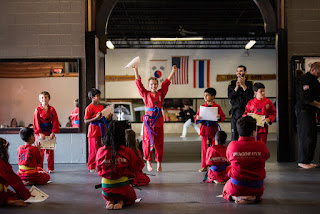
 

Thursday, January 12, 2023

I can’t imagine how bad I would feel like mentally and physically if I didn’t train Tae Kwon Do at least once a week.

Early this week, sent out an anonymous survey to my Tae Kwon Do students at the Dragon Gym in Exton, PA.  Here's what one of them had to say about the physical and mental benefits of the training: 

I can’t fathom the mental and physical state I would find myself in without consistent workouts. I never realized how valuable goal-oriented training was until I had to test for it. It wasn’t just about blindly punching and kicking my way through a dojang, it was so much more than that. The sense of achievement after successfully passing each level of examination was significant. 

In addition to helping with my concentration, Tae Kwon Do has improved my strength and balance tremendously. Just by attending weekly classes and completing each move or technique correctly, I have seen a huge difference in my physicality. With precise precision, my co-ordination has also been significantly heightened. Even though practice doesn’t necessarily make perfect, practicing regularly certainly helps improve one’s performance over time. 

That being said, one of the many advantages of training in Tae Kwon Do are the life lessons learned within each class. Self-discipline and respect for oneself as well as for others are only some of the traditional values instilled within students at varying levels throughout their journey. Of course there’s more to it than just turning up to class every week; there are different poomsae or forms which must be perfected before tests are taken and knowledge of martial arts history is tested to ensure understanding on how these techniques were developed since ancient times. 

By learning Tae Kwon Do and using it as an exercise routine, not only am I able to physically challenge myself but also mentally challenge myself too by pushing myself out of my comfort zone - something which wouldn't normally occur in other forms of fitness regimes such as aerobics or Pilates - unless those activities come with similar goal setting requirements that often accompany certification processes like in Tae Kwon Do! 

Although testing is an inevitable part of any martial art training program, there is a large benefit that comes from regular practice and dedication no matter what belt level you achieve; personal growth on all levels including physical, mental & spiritual attunement with yourself & your surroundings! This self exploration is something that should never be underestimated; if you don't train at least once a week you will miss out on all its benefits!

Wow!  I hope you find this as inspiring as I did, and you'll join us at the Dragon Gym! 

Wednesday, January 4, 2023

What's the best martial arts for kids to start with?

This is a common question from parents searching out a Martial Arts program for their children. 

Martial arts is an excellent way for kids to learn the self-discipline and physical skills necessary for their development. For young children, it can help build confidence and discipline from a young age. The best martial arts for kids depend on the individual's needs, age, and goals. 

Martial arts such as karate and tae kwon do are popular choices due to their emphasis on technique, respect and tradition - all of which can be beneficial to kids in their growth and development. 

Other options include judo, aikido and Brazilian Jiu-Jitsu - all of which offer various benefits depending on the student's needs. Ultimately, when choosing a martial art for your child it is important to find something that suits them both physically and mentally while offering a safe learning environment with knowledgeable instructors.

Tae Kwon Do is one of the most popular martial arts for kids due to its focus on discipline, respect, and tradition. 

It is a great way to help young students learn physical skills while developing strong values such as self-control and respect for others. Tae Kwon Do also focuses heavily on technique, helping students to develop their balance, coordination, and agility. With its emphasis on tradition and honor, Tae Kwon Do offers a unique blend of mental and physical challenges that can help kids become more confident in themselves.

A Tae Kwon Do program offers a range of benefits for children. 

Including physical fitness, increased concentration and coordination, self-control and respect for others, and improved balance and agility. 

It also provides students with a unique opportunity to learn discipline, tradition, and respect in a safe learning environment. Additionally, Tae Kwon Do offers the opportunity for martial arts competitions which help to boost confidence and provide an outlet for healthy competition. Finally, Tae Kwon Do can be ideal for children due to its emphasis on technique over strength; this allows kids of all skill levels to take part in the sport regardless of their size or age.

Although a Kids Taekwondo Program can be extremely beneficial for physical, mental, and emotional development, there are a few limitations that should be kept in mind. 

First, kids may have difficulty following strict rules and regulations with regards to discipline. Additionally, the time commitment required to master the techniques of Tae Kwon Do can often be quite high and may not be suitable for parents that are unable or unwilling to get their kids to practice. Finally, because of its focus on technique over strength, very young or physically weaker students may find it difficult to excel at Tae Kwon Do at higher levels.

It's important for kids to learn elements of Muay Thai and Brazilian Jiu Jitsu in addition to Tae Kwon Do because it helps them develop skills that are beneficial in different contexts. 

The additional martial arts features aspects such as ground combat, submission holds, and kicks which can be especially helpful in self-defense scenarios. Muay Thai also introduces students to the concept of using elbows and knees in a fight, whereas Brazilian Jiu Jitsu teaches students effective ways of using leverage when grappling with an opponent. All of these skills can help children become more rounded and better equipped martial artists.

In addition to the physical and self-defense aspects, martial arts programs should also focus on teaching children the importance of respect, discipline, control, and focus. 

Martial arts is not just about learning techniques – it’s also about developing a strong moral code. Martial arts helps children learn important life skills such as respect for authority, trusting their instincts, putting in hard work and dedication, understanding what it means to have mental fortitude and persevere in difficult circumstances. Ultimately, martial arts provides a valuable framework for kids to develop all-around positive character traits that will benefit them both inside and outside the dojang.

When choosing a martial arts school for their child, parents should consider several factors. 

First, they should research the instructor and make sure they are knowledgeable, certified, and experienced in teaching martial arts. 

Second, they should observe a few classes to get an idea of the teaching style and atmosphere. 

Third, they should read online reviews or ask parents already enrolled in the program how they feel about their experience. Lastly, they should make sure the facility is safe and up-to-date with all safety protocols. 

Ultimately, it’s important for parents to ensure that their child will be learning in an environment that is conducive to both physical and personal growth.


Sunday, January 1, 2023

The Differences Between Traditional Tae Kwon Do and Sport Taekwondo - TKD Classes in Exton, PA

What are the main differences between Traditional Tae Kwon Do and Sport Taekwondo? 

The main difference between sport taekwondo and traditional tae kwon do lies in their focus. Sport taekwondo focuses more on competition and physical fitness, while traditional tae kwon do has a greater emphasis on self-defense and moral development. In sport taekwondo tournament matches, point scoring is the primary consideration, whereas with traditional tae kwon do the goal is to master technique for the purpose of recovery from an attack or defense against one. Traditional tae kwon do also places a strong importance on proper etiquette and formality, whereas sport taekwondo does not.

It's important to study both the sport and traditional aspects of Tae Kwon Do in order to gain a diverse set of skills. Studying the sport aspect will give students an understanding of competition, point scoring, and sparring techniques that can be applied in real-life self-defense situations. By studying the traditional aspect, students will learn discipline and physical development as well as more practical self-defense techniques such as kicks, strikes, blocks, and joint locks. In addition, combining the two disciplines gives students an opportunity to develop both mentally and emotionally while attaining a higher level of martial arts proficiency.

Learning sport Taekwondo is beneficial even if one isn't actively competing as it still provides physical, mental and emotional benefits. Physically, it improves muscular strength, flexibility and coordination. Mentally, it helps the learner focus on complex tasks and become more efficient in problem-solving. On an emotional level, it can help build confidence and self-esteem as well as teach discipline. Furthermore, learning sport taekwondo can lead to increased success in other endeavors such as academics or sports.

Studying traditional Tae Kwon Do can be incredibly valuable, even if learning self-defense is not a primary goal. Traditional Tae Kwon Do involves more than just physical technique; it also focuses on improving mental and emotional aspects of the learner. This includes mastering proper etiquette, building discipline, developing confidence and self-esteem, and focusing on problem solving skills. Furthermore, traditional Tae Kwon Do can improve flexibility, speed, power and overall physical fitness. Ultimately, no matter what the primary goal is in studying traditional Tae Kwon Do, there are numerous benefits to gaining knowledge in this martial art.

Traditional Tae Kwon Do Programs often incorporate techniques from other martial arts such as Muay Thai, Boxing, and BJJ. This helps to create a more comprehensive martial art practice that combines the strengths of different disciplines. For example, Muay Thai provides a strong focus on striking and self-defense, while Boxing emphasizes hand technique and physical conditioning. Brazilian Jiu-Jitsu (BJJ) provides an effective ground fighting component with its focus on grappling, submission holds, and chokes. By combining these styles together in one program, practitioners can become well-rounded in their martial art education.


The Dragon Gym has been offering both Traditional and Sport Taekwondo Classes in Exton, PA for the last 50 years! Exton, Pennsylvania is a vibrant suburban town located in the heart of Chester County. The town offers easy access to downtown Philadelphia with its convenient public transit links and closeness to major highways such as I-76, I-95, and the Turnpike. With a population of over 7,000 residents, Exton boasts of attractive neighborhoods, ample shopping options, plenty of outdoor recreation activities, and numerous cultural attractions. It's also home to several businesses and institutions such as Penn State Great Valley Campus and a variety of tech companies. 


Thursday, December 29, 2022

Tae Kwon Do in Exton, PA - How do Kids Taekwondo Classes Help them do well in school and get better grades?

How do our Kids Taekwondo Classes Help Students do well in school and get better grades?

For parents looking to give their kids an extra edge in school, consider enrolling them into Tae Kwon Do classes! Studies have found that children who participate in regular martial arts training tend to show higher scores at the end of each semester. The Dragon Gym in Exton, PA provides specialized instruction depending on your child's experience level and age group; with six sessions a week available, you'll find one just perfect for your little scholar-warrior! 

So what are some of the ways Tae Kwon Do Classes can help improve academic performance? 

1. Increased physical health - 

Through repetition of kicks, blocks and stances students will build strength and coordination while toning muscles they didn’t even know existed. This improved physical health can lead to increased energy levels which helps with concentration and focus in the classroom.

2. Improved mental acuity - 

Discipline, focus and persistence are attributes children gain through regularly studying martial arts techniques. These skills are essential to success in the classroom and often give students an edge over other peers when it comes to finishing assignments and taking exams.

3. Conflict resolution - 

As children learn self-defense moves they also learn valuable lessons about dealing with conflicts faced every day inside and outside of school. With these skills, kids will be able to act more assertively under pressure resulting in fewer emotional outbursts when faced with difficult situations throughout their academic career.

4. Stress relief - 

After a long day of learning there is nothing like an hour of intense physical exercise followed by deep stretching to let go of all stress built up throughout the day resulting in improved concentration during class time as well as better quality sleep at night for increased productivity overall during the school year.


Saturday, March 7, 2015

The Elements of a typical traditional martial arts class west chester pa

Are you looking to join your local karate club or have you already taken the first step and signed up? If you haven't yet visited your local martial arts school, you're probably wondering what a typical karate class looks like. This article will break down the main elements of a good karate class.

Obviously not every club will follow this format and within each martial arts school the weekly classes will also change but this is meant to be a guide of what to expect in general.

Classes also vary in length ranging from short 30 minute classes for young kids to 1 hour classes or longer for older kids, teenagers and adults. The following example is based on a one-hour class and not all of these elements will be covered in each lesson.

1. Formal etiquette The majority of karate schools adhere to some kind of formal etiquette at the beginning and end of each class. This practice can be attributed to traditional Asian culture where bowing and formal chanting are often used to begin and end any type of structured activity. Depending on your chosen karate school you could see the full routine of formal etiquette including kneeling, multiple bows and the verbal recital of the school creed to a more laidback approach of an informal hand clap followed by the words, "Let's begin".

2. Warm-up and stretching Before any type of physical activity it is highly recommended that you warm-up and stretch. It is often a good idea to end the activity with more stretching (sometimes called a warm-down). Karate is a very physical activity and so it should be obvious that a warm-up is an integral part of each lesson.

3. Practice of basic techniques Right after the warm-up ends many karate classes begin with basic practice. This includes drilling stances, punches, kicks, blocks and strikes on the spot and up and down the floor with the focus being on multiple repetitions of the main techniques required for each rank level.

4. Forms practice Forms are pre-defined sequences of techniques that a practitioner must memorize. The forms are often a main requirement for each test, and they help the practitioner to understand how different techniques fit together and integrate into sets of techniques. There are many different forms and each one has a set pattern with a central focus.

They are often likened to the martial arts equivalent of a dance routine but most forms have accompanying application drills that show how each technique can be used against an opponent in a self-defense situation.

5. Short break Depending on the length and intensity of each class, practitioners are often given the chance of a short "water break."

6. Partner work drills These types of drills are usually one of the fun parts of a karate class because the practitioners get to practice their techniques with an opponent to see how they are used and to drill appropriate reactions to different types of attacks. Partner work drills aren't always limited to two people but can often include multiple opponents or group training drills. This usually depends on the creativity of the instructor and the overall level of the class.

7. Pads and targets An important part of karate training is to practice your techniques against different types of targets. These targets include soft or hard focus targets, body shields, hanging bags or the more popular free-standing Wavemasters, plastic sheets and even wooden boards from time to time. Pads and targets are usually a lot of fun for all involved and give you a real sense of what it feels like to actually strike a target.

8. Conditioning drills This is really where your level of fitness can improve dramatically. Conditioning drills include running, jumping, push-ups, sit-ups, jumping jacks, star jumps, squats, relays, and any number of stamina-focused activities. Depending on the level of the class and the age group these drills are not always for the light-hearted but you did want to get a good workout, didn't you?

So in a nutshell a typical karate class will include some or all of these different elements.

For more information about the programs at Dragon Gym, please visit our main website:

Saturday, February 21, 2015

Kids Martial Arts west chester pa

The Kids Martial Arts program at the Dragon Gym will really help to arm your child with a host of positive mental and physical skills that will help them in school, at home, and in life.


The Martial Arts will improve your child’s grades.

The unique Dragon Gym Kids Martial Arts (Moo do) System offers a lot more than just self-defense and physical agility.  Our educational martial arts program and unique achievement program will teach your child history, geography, safety and much more.  The best part of all is that the Martial Arts will give your child the self-discipline to study.  This leads to increased concentration at school and pays off in the form of better grades.

The Martial Arts develop your child physically.

The martial arts will also help your child develop physically.  Our programs increase speed stamina, and strength in children.  The program also develops balance, coordination, and timing.  This will help in sports and all activities.

The Martial Arts develop your child mentally.

Perhaps the scariest problem facing many parents today is the thought that their child might get involved in drugs.  The number of “good kids” taking drugs at a younger and younger age is staggering.  We help promote anti drug programs.  On top of this our programs are designed to promote self-confidence and self esteem which gives your child the courage to say NO in the face of peer pressure.  Recent studies have shown that programs that focus on personal achievement such as martial arts are vastly more effective in this area than team sports.

The Martial Arts promote leadership skills in children to help them succeed in life.

Dragon Gym programs will teach your child about setting goals, leadership, and taking responsibility.  These qualities more than any others will help your child ensure their success in school, in college, and in life.

The Martial Arts teach children self-defense skills that save their lives.

While we wish it were not even a factor in our program, the fact remains that we live in a world full of undesirable people.  The martial arts will teach your children how to protect themselves from danger. 


Your Child will enjoy the Martial Arts because our high-energy classes are full of excitement and Fun!

Perhaps the best part of our program, from the children’s point of view, is just how much fun the classes really are.  Our high-energy classes will focus your child’s energy in a positive and productive manner.

Martial Art training at Dragon Gym will provide your child with personal attention not found in other schools.

We focus on quality instruction and personal attention to our students.  All our classes are taught by highly trained instructors committed to excellence and continued learning.  When you enroll your children in the Dragon Moo Do System, you can feel safe with the knowledge that they will be receiving the finest instruction available. 

Not all Martial Arts Schools are created equal.

Few Schools in the country have the unique combination of martial arts, education, facility and leadership that you will find with our programs.


Our Team of over 20 instructors is the finest anywhere in the world.  Each instructor is highly qualified and experienced, trained directly under Master Sikdar and Master Beck.  It is each instructor’s primary goal to make every effort to provide you with a safe, fun and educational Martial Arts Program

Master Somnath Sikdar

Somnath has been training in Martial Arts for almost 30 years and has attained the rank of 5th Degree Black Belt.  His training has covered a broad spectrum of martial arts to include a variety of weapons, self-defense, traditional and sport Tae Kwon Do.   In addition, he was the President, Head Instructor, and Coach of the University of Pennsylvania WTF Tae Kwon Do Team

Master Lonnie Beck

Lonnie combines his experience in Western Athletics and Eastern Martial Arts to effectively instruct both the children and adult students of the Dragon Gym.  Through over 25 years of intense training in Tae Kwon Do, Hapkido, and a variety of weapons Lonnie attained the rank of 4th Degree Black Belt. 

We offer convenient schedules & affordable rates.


The Dragon Gym is open six days a week and offers convenient schedules.  So make an investment in your children that will pay off for the rest of their lives.